


SciMed
Ocular Prosthetic Eye — Hand-Painted Medical-Grade Acrylic | 13 Colors, 6 Sizes (18–28mm)
Ocular Prosthetic Eye — Hand-Painted Medical-Grade Acrylic | 13 Colors, 6 Sizes (18–28mm)
Couldn't load pickup availability
Fit to your exact size, shade, and side — hand-crafted by our US manufacturer at $75 direct, not $150–$400 through a distributor or $2,000+ through a custom fitting. Each SciMed prosthetic eye is medical-grade acrylic (PMMA), hand-painted with layered iris pigmentation and red silk fiber veining to replicate the appearance and light reflection of a natural eye. Designed for patients replacing a worn prosthesis, patients seeking a spare, and for ocularist / clinic procurement.
🛡️ Our Custom-Fit Promise
Every prosthetic eye is fit to your exact specification. There is no "default" or "assorted" fulfillment — this is a personal medical device and we treat it that way.
- Select your size (18, 20, 22, 24, 26, or 28 mm), shade (13 options), and side (left or right) at checkout via the variant dropdown.
- If your exact combination isn't listed as a variant, email sales@scimedstore.com BEFORE ordering with your details — we'll confirm we can fulfill your spec.
- Full refund if we can't match your specification — you'll never receive a prosthesis you didn't specifically choose.
- Custom shade matching available — send a photo of your remaining eye in natural lighting, our team will paint to match at no extra charge.
Who this is for
This product is designed primarily for:
- Patients replacing a worn prosthesis — you've been fit by an ocularist before, you know your exact size and shade, your current prosthesis is 2–3 years old and due for replacement. Order the same specification you're currently wearing.
- Patients seeking a spare / backup prosthesis — many patients keep a second prosthesis for travel or emergencies. This is that spare, at 20% of the distributor cost.
- Ocularists and ophthalmology clinics — see our Pack of 10 clinical inventory option or scroll to the clinic procurement section below.
- International patients — where local ocularist access is limited or ocularist prostheses are unaffordable at local pricing. Ships worldwide via DHL Express.
- Veterans and APO/FPO military patients — ships to APO/FPO/DPO addresses.
Not the right fit if you're brand new to prosthetic eyes
If you've never been fit for a prosthetic eye, please see an ocularist or ophthalmologist for sizing first — it's a quick clinical measurement and ensures the size fits your orbital anatomy correctly. Once you know your size + shade + side from that first fitting, come back and order here for $75 vs the $2,000+ custom price. See our complete care and types guide for an overview of the initial fitting process.
📦 How to order
- Select your variant from the dropdown above: shade + size + side (e.g. "Dark Brown / 24 mm / Left").
- Verify the specification before adding to cart — this is a personal medical device, take a moment to confirm size and side.
- If your exact combination isn't in the dropdown, email sales@scimedstore.com with your specification — do not order until we confirm.
- Same-day dispatch on orders placed before 2 PM Pacific Time; delivery typically 2–5 US business days, 5–14 days for APO/FPO, 3–7 days international via DHL Express.
- Receive your prosthesis in a sterilized safety case, plain outer packaging, with instructions for care.
- Not satisfied? Full refund within 30 days if the specification doesn't match what you ordered or the prosthesis has any manufacturing defect.
What you're getting
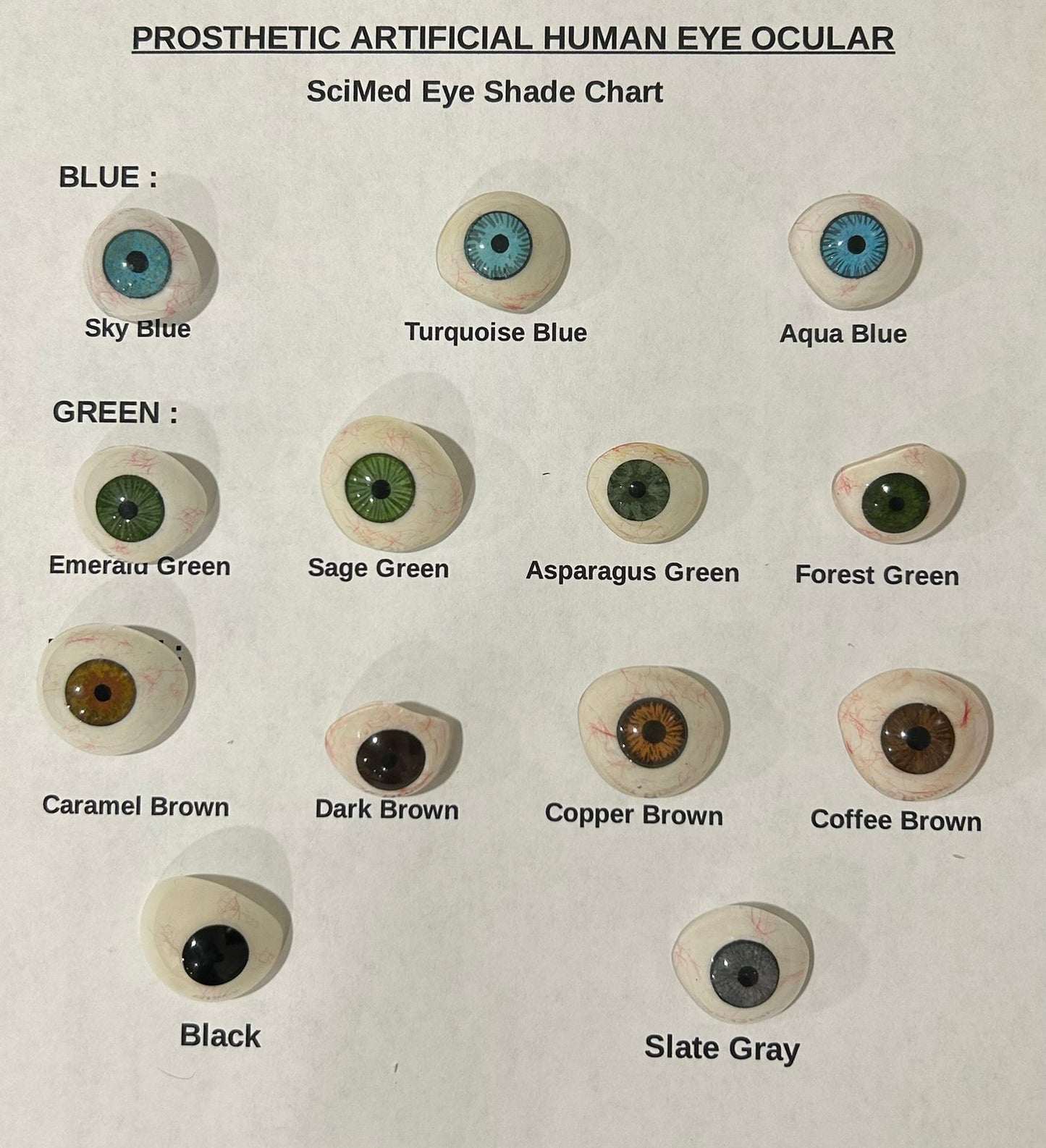
- 13 hand-painted color shades — Sky Blue, Turquoise Blue, Aqua Blue, Emerald Green, Sage Green, Asparagus Green, Forest Green, Caramel Brown, Dark Brown, Copper Brown, Coffee Brown, Black, Slate Gray. Layered pigmentation gives natural iris depth and texture.
- 6 sizes — 18 mm, 20 mm, 22 mm, 24 mm, 26 mm, 28 mm. Most adult patients fit 20–26 mm; pediatric patients typically 18 mm.
- Left and right side — select your affected side at checkout.
- Red silk fiber veining — mimics natural scleral vessel patterns for a lifelike appearance.
- Smooth polished acrylic surface — conforms to ocular tissue for comfort and natural prosthetic motility (typically 70–85% of natural eye movement).
- Sterilized safety case included — hygienic packaging, ready for immediate use.
- Care instructions — daily rinse + weekly cleaning routine included.
Clinical applications
- Post-enucleation replacement prosthesis — for patients whose current acrylic prosthesis has reached end of service life (2–3 years typical)
- Post-evisceration replacement prosthesis — same, for patients with residual scleral shell
- Spare / backup prosthesis — many patients keep a second prosthesis for travel, emergencies, or as backup during cleaning/polishing
- Pediatric anophthalmia staged replacement — as the child grows and needs progressively larger devices (18mm typically for early stages)
- Ocularist clinical trial-fit inventory — see our Pack of 10 option
- International clinic supply — where distributor pricing at $150–$400 puts prostheses out of reach for patients
Living with a prosthetic eye
Wearing a prosthetic eye becomes routine within a few weeks. Here's what to expect day-to-day:
- Daily wear: Most patients wear their prosthesis from morning until bed — 14–16 hours per day is normal. You do NOT need to remove it every night; many patients only remove it for weekly cleaning.
- Sleep: You can sleep with your prosthesis in. Some patients prefer to remove it and store in saline overnight — either approach is fine. Do not sleep in a brand-new prosthesis during the first 2 weeks while tissue adjusts.
- Showering, swimming, exercise: All safe. Saline and fresh water are fine. Chlorinated pool water is fine short-term; rinse the prosthesis with fresh water after swimming. Salt water is safe.
- Crying: Yes, you can cry. Your remaining lacrimal glands produce tears normally, and tears will flow past the prosthesis as they would past a natural eye.
- Sports and physical activity: Full participation possible. For contact sports, ask your ophthalmologist about protective eyewear.
- Handling and touching: Wash hands first. Handle over a soft surface (bed, towel) — dropping onto tile can chip the surface.
- Weekly cleaning: Remove, gentle soap and warm water, rinse with saline, polish monthly with a soft cloth. Do NOT use alcohol — it dries the acrylic and can cause cracking.
- Replacement cycle: Most patients replace every 2–3 years as the acrylic surface wears from cleaning and body-fluid exposure. A spare shortens downtime.
Specifications
| Material | Medical-grade acrylic (PMMA) — not glass |
|---|---|
| Manufacturing | Hand-painted iris, layered pigmentation, red silk fiber veining |
| Sizes available | 18, 20, 22, 24, 26, 28 mm (horizontal diameter) |
| Colors available | 13 natural shades (blue, green, brown, gray, black families) |
| Laterality | Left or Right (select at checkout) |
| Surface finish | Smooth polished acrylic, conforming surface |
| Motility | Typically 70–85% of natural eye movement |
| Packaging | Individual sterilized safety case |
| HS / HTS code | 902139 (artificial parts of the body) |
| HCPCS billing code | V2623 (Prosthetic eye, plastic, custom) |
| Ships from | California |
| Brand / Manufacturer | SciMed Scientific Equipment LLC |
| MPN | SCM-OPE (base model — full MPN varies by variant SKU) |
| Expected service life | 2–3 years (depends on patient handling and cleaning routine) |
| HSA / FSA | Eligible under HCPCS V2623 (prosthetic eye) |
| Medicare | Not reimbursed by traditional Medicare when bought from SciMed (SciMed is not Medicare-enrolled) |
Why patients choose SciMed direct
- Manufacturer-direct pricing — $75 vs $150–$400 distributor, vs $2,000+ custom ocularist fitting
- Custom-fit to your exact spec — no "assorted" shipments, ever. Money-back if we can't match.
- Hand-finished and shipped from California — each prosthesis ships from San Jose, California
- Same-day US dispatch on orders before 2 PM Pacific
- Real US-based support — sizing, shade matching, or replacement questions go directly to the San Jose team
- HSA / FSA eligible under HCPCS V2623 — itemized receipts available on request
- International shipping via DHL Express worldwide with DDP terms for GCC, MENA, UK, EU, AU/NZ clinical accounts
- APO/FPO military-address friendly — ships via USPS Military Mail
- Discreet packaging — plain outer carton, no clinical labeling visible
Frequently asked questions
Custom-fit & ordering
Will you really ship the exact size and shade I select?
Yes. Every prosthetic eye is fit to your exact variant selection (size + shade + side). We do not ship "assorted" or "default" prostheses. If your exact combination isn't shown as a variant, email sales@scimedstore.com BEFORE ordering. Full refund if what you receive doesn't match what you ordered.
What if the color doesn't match my remaining natural eye?
Email sales@scimedstore.com with a photo of your remaining eye in natural lighting BEFORE ordering. We'll recommend the closest match from our 13 shades. For custom shade matching, our hand-painting team can match specific iris patterns, heterochromia, sectoral coloration, or unusual limbal rings at no extra charge for standard match; complex custom work at a $50 surcharge.
Can you paint a custom iris to match a specific photo?
Yes. Send a well-lit natural-lighting photo of your remaining eye to sales@scimedstore.com with your order. Our team can match iris pattern, secondary limbal rings, scleral vessel density, and pupil size to align with the remaining eye. Standard photo-based match at no extra cost; complex pattern work at $50 surcharge.
How do I know what size to order?
If you've been fit before, order the same size you currently wear. If you've never been fit, see an ocularist or ophthalmologist for sizing first — it's a quick clinical measurement. The most common adult sizes are 22, 24, and 26 mm. Pediatric sizes typically start at 18 mm.
What's the return policy?
Full refund within 30 days if the prosthesis you receive doesn't match your specification (size, shade, side) OR has any manufacturing defect. Because this is a personal medical device that sits against ocular tissue, we cannot accept returns on a prosthesis ordered correctly and then no longer wanted — but if we made the error, we make it right.
What if I lose or break my prosthesis?
Order a replacement here at $75. Most patients keep a spare prosthesis for exactly this reason. If you know your size and shade from your original fitting, reorder the same specification. If you don't remember, email sales@scimedstore.com with a photo of your remaining eye and we'll help identify the correct spec.
Living with a prosthetic eye
Can I sleep with my prosthetic eye in?
Yes — sleeping with an acrylic prosthetic eye is safe and common. Many patients wear their prosthesis 24/7 and only remove it for weekly cleaning. Some patients prefer to remove it and store in saline overnight — either approach is fine. Do not sleep with it in during the first 2 weeks after receiving a new prosthesis while the socket adjusts.
Can I swim, shower, or exercise with my prosthetic eye?
Yes to all three. Saline and fresh water are safe. Chlorinated pool water is fine short-term — rinse the prosthesis with saline or fresh water after swimming. Salt water is safe. Hot tubs and heavily chlorinated pools should be limited. Exercise, gym, and non-contact sports are fine with the prosthesis in place. For contact sports, wear protective eyewear.
Does wearing a prosthetic eye hurt?
No — once properly fit, a prosthetic eye is comfortable enough to wear all day without pain. If you experience pain, redness, discharge, or the sensation of the prosthesis rubbing, see your ophthalmologist — the fit may need adjustment or the socket may have an infection needing treatment.
How do I insert and remove the prosthesis?
Insertion: hold the prosthesis with the wider edge horizontal, lift your upper eyelid, slide the top of the prosthesis under the upper lid, then let go and pull down your lower lid. The prosthesis settles into place. Removal: pull the lower eyelid down and gently press upward on the bottom of the prosthesis to pop it out into your other hand. A suction cup tool can be used if you prefer. Practice over a soft surface until you're comfortable.
Can I cry with a prosthetic eye?
Yes. Your remaining lacrimal (tear) glands produce tears normally. Tears flow past the prosthesis just as they flow past a natural eye. Emotional tears, wind-induced tears, and reflex tears from bright light all work as normal.
Will people be able to tell it's not my real eye?
With a well-fit hand-painted prosthesis matched to your natural eye color, most people cannot tell. The iris pattern, scleral vessels, and light reflection are painted to mimic a natural eye. Motility is typically 70–85% of natural eye movement, which is enough for casual social interaction not to reveal the prosthesis. Extended direct eye contact under bright lighting may reveal slight motility differences.
Will the prosthetic eye move with my other eye?
Yes — to a significant degree. The prosthesis sits over your orbital implant, which is attached to your eye muscles. When you move your good eye, the muscles move the implant, which moves the prosthesis. Motility is typically 70–85% of natural eye movement.
How long does an acrylic prosthesis last?
2–3 years on average with proper cleaning. The acrylic surface eventually wears from body-fluid exposure and cleaning. Most patients buy a spare for backup or upgrade replacement at end of service life. See our care and replacement guide.
How do I clean it?
Daily rinse with saline. Weekly cleaning with mild soap and warm water. Polish once a month or as needed with a soft cloth. Do NOT use alcohol — it dries the acrylic and can cause cracking. Do NOT use abrasive cleaners.
Clinical & medical
I just had my eye removed. When should I get a prosthesis?
Typically 6–12 weeks after enucleation or evisceration surgery, once the orbital implant has healed. During the healing period, you'll wear a clear conformer to maintain the eye socket shape. Your ophthalmologist will confirm when you're ready for prosthesis fitting.
What's the difference between an acrylic prosthesis and a scleral shell?
A full acrylic prosthesis (this product) replaces a missing eye following enucleation surgery — the acrylic prosthesis sits over the orbital implant. A scleral shell is a thinner prosthesis worn over an existing but disfigured or non-functional natural eye — the eye is still present but a shell covers it for cosmetic purposes. Ask your ophthalmologist which type you need.
Is this a glass eye or an acrylic eye?
It is a modern acrylic (PMMA) prosthetic eye — not literal glass. Since the 1940s, acrylic has been the clinical standard because it is safer, more durable, and holds hand-painted iris detail better than glass. The term "glass eye" is still widely used in everyday language to describe any prosthetic eye. This product is what people mean when they say "glass eye" today.
Can a child wear this prosthesis?
Yes. The 18mm size is designed for pediatric patients. Children with anophthalmia (congenital absence of the eye) or microphthalmia go through staged prosthetic fitting starting in infancy with progressively larger devices. Pediatric prosthetic fitting should always be managed by a pediatric ophthalmologist and ocularist working together.
Do I need a prescription to buy a prosthetic eye online?
No. Prosthetic eyes are classified as Class II medical devices in the US but do NOT require a prescription for direct purchase. However, if you have never been fit before, we strongly recommend an initial clinical fitting by an ocularist or ophthalmologist to determine the correct size and shade for your orbital anatomy.
Where do SciMed prosthetic eyes ship from?
All SciMed prosthetic eyes ship from San Jose, California. This is not a drop-ship product from overseas. Each prosthesis is inspected before dispatch. Manufacturer address: SciMed Scientific Equipment LLC, 163 Silcreek Drive, San Jose, CA 95116.
Cost, insurance & shipping
How much does a prosthetic eye typically cost?
Direct from manufacturer (like SciMed) — $75 for a standard prosthesis. Through medical distributors — $150–$400 per prosthesis. Custom-fit by an ocularist — $2,000–$4,000 per prosthesis, of which the acrylic prosthesis itself is a small fraction (the fee is primarily for the fitting and hand-painting time). Medicare and most insurance cover ocularist-fit prostheses as durable medical equipment.
Is a prosthetic eye HSA or FSA eligible?
Yes. Ocular prostheses are HSA/FSA eligible under HCPCS V2623 (prosthetic eye, plastic, custom). SciMed provides itemized receipts on request — email sales@scimedstore.com after ordering.
Does Medicare cover a prosthetic eye?
Medicare Part B covers medically necessary ocular prostheses only when supplied through a Medicare-enrolled supplier, typically an ocularist. SciMed is not a Medicare-enrolled supplier, so purchases from SciMed are not reimbursed by traditional Medicare. SciMed prostheses are HSA/FSA eligible. Contact your Medicare carrier for pre-authorization requirements.
Does private insurance cover the cost of a prosthetic eye?
Most private health insurance plans cover ocular prostheses under durable medical equipment. Check your policy for HCPCS code V2623 coverage. SciMed provides itemized receipts for reimbursement on request. HSA and FSA funds may also be used.
Can veterans get a prosthetic eye through the VA?
Yes. VA facilities dispense prosthetic eyes to eligible veterans through their Ophthalmology and Prosthetics services. SciMed supplies VA facilities directly as a SAM.gov compliant vendor.
Do you ship to APO/FPO military addresses?
Yes. SciMed ships to APO, FPO, and DPO military addresses in the US, Europe, and Asia-Pacific commands. Same-day dispatch applies. USPS Military Mail is the fastest and most reliable option; delivery typically 5–14 days depending on destination command.
Do you ship internationally?
Yes — we ship worldwide via DHL Express. For clinic procurement to GCC, MENA, UK, EU, AU/NZ, we offer DDP (delivery-duty-paid) terms via sales@scimedstore.com. Individual international patient orders ship at calculated DHL rates.
Ocularist practice or clinical account?
For ocularists, ophthalmology clinics, hospital eye departments, academic medical centers, and VA facilities:
- Volume pricing on 10+ unit orders — see our Pack of 10 Brown Shades at $599.99 (~$60/unit) or email for custom shade mixes
- Net-30 invoicing for verified clinical accounts
- SAM.gov / VA procurement compliant
- Custom shade matching at no extra charge — send photo of patient's remaining eye
- International DDP for GCC, MENA, UK, EU, AU/NZ clinic procurement
- Same-day US dispatch — trial-fit inventory ready when your patient walks in
Shipping: Free shipping on orders $100+ in the US, discreet packaging. International orders ship worldwide via DHL Express at calculated rates. APO/FPO ships via USPS Military Mail. Clinic procurement (DDP) available for GCC, MENA, UK, EU, AU/NZ buyers via sales@scimedstore.com.
Share


Enquiry Form
Contact form
Ocular Prosthetic Eye Prosthesis – Human Artificial Eye
Discover the perfect blend of historical craftsmanship and realism with our Vintage Human Prosthetic Eye. Designed to replicate natural ocular aesthetics, this brown-colored artificial eye is ideal for medical collectors, educators, and special effects professionals seeking authenticity and detail.
Key Features:
- Vintage Aesthetic: Classic prosthetic eye design with intricate detailing.
- Realistic Shades: Available in Brown, blue, green, & gray.
- Premium-Quality Materials: Durable, non-toxic, and expertly polished for longevity.
- Versatile Applications: Ideal for medical exhibits, prosthetic demonstrations, film props, and anatomical studies.
- Lightweight & Comfortable: Designed for effortless handling and display.
Why Choose SciMed’s Vintage Prosthetic Eye?
- Authentic Vintage Design: Crafted to reflect the classic aesthetics of prosthetic eyes.
- Premium Quality: Made from durable, high-grade materials for long-lasting use.
- Realistic Appeal: Expertly designed to mimic the natural look of a human eye.
- Versatile Use: Ideal for medical training, historical displays, or educational demonstrations.
A Timeless Addition to Your Collection or Practice
Whether you’re a medical professional seeking a unique teaching tool or a collector with an eye for vintage medical artifacts, our Brown Color Vintage Human Prosthetic Eye is a standout choice. Its classic design and lifelike appearance make it a versatile and valuable addition.