SciMed
Schiotz Indentation Tonometer — 3 Weights (5.5g/7.5g/10g), Agate Bearing, IOP Measurement
Schiotz Indentation Tonometer — 3 Weights (5.5g/7.5g/10g), Agate Bearing, IOP Measurement
Couldn't load pickup availability
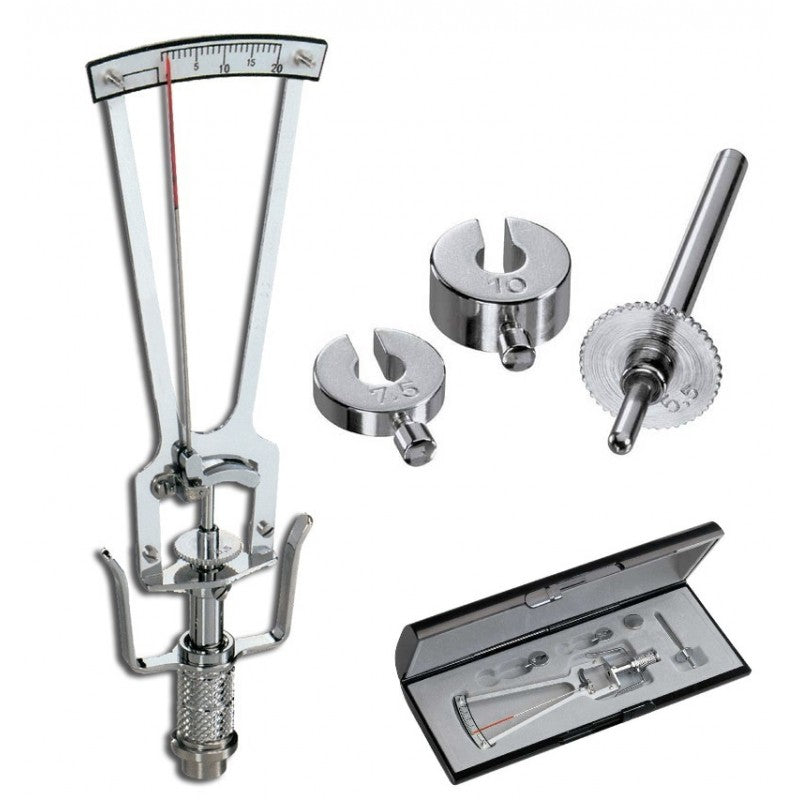
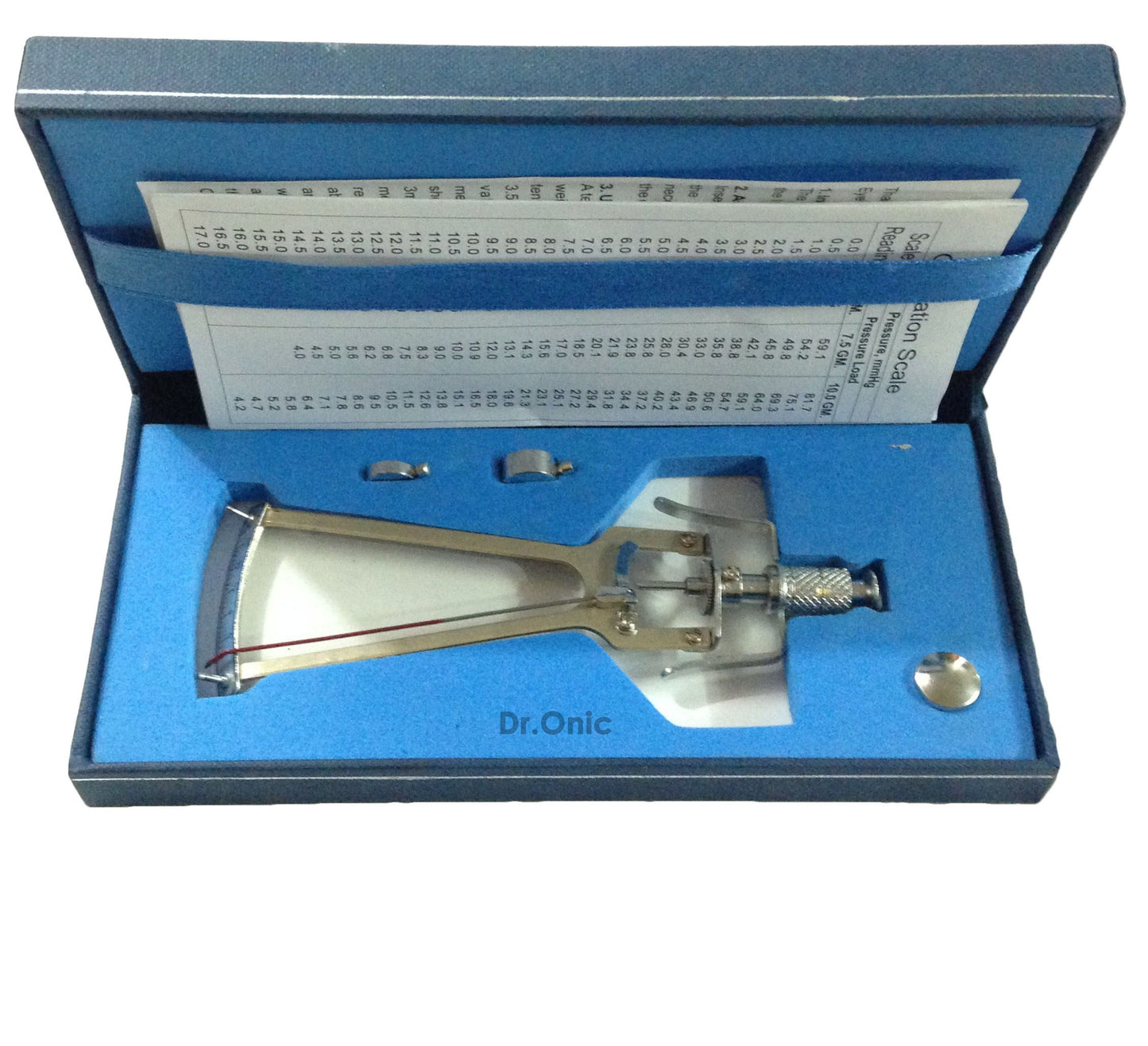
Schiotz indentation tonometer — the essential portable IOP measurement device for glaucoma screening in settings where slit-lamp-mounted Goldmann applanation tonometry isn't available. Complete original set: tonometer body + plunger + 3 weights (5.5g, 7.5g, 10g) + IOP conversion table + blue deluxe case with velvet inserts. High-quality agate bearing for extremely long service life. Precision measurement on 0-20 subdivision scale (with 0 to -1 sub-divisions for over-range readings). Perfect scale reading via red pointer. All vital parts stainless steel, other parts chrome-plated. $199 direct.
Complete kit contents
- Schiotz tonometer body (stainless steel + chrome-plated)
- Precision plunger (agate bearing)
- 3 weights: 5.5g (low IOP), 7.5g (medium IOP), 10g (high IOP)
- Scale-to-IOP conversion table (converts subdivision reading + weight to mmHg)
- Blue deluxe case with velvet-look inserts
- User manual + IFU
Applications
- Glaucoma screening — primary care + community screening where Goldmann applanation isn't available
- Emergency + urgent care IOP — acute angle-closure glaucoma diagnosis + red-eye workup
- Rural + underserved clinical settings — no slit lamp / no Goldmann
- Bedside IOP in supine patients — hospital + nursing home + ICU (Schiotz is one of few options that works supine)
- Post-operative IOP monitoring — post-cataract, post-glaucoma surgery IOP check
- Veterinary ophthalmology — canine + feline + equine + large animal IOP measurement
- NGO glaucoma outreach — cataract + vision camps needing portable IOP
- Optometry + ophthalmology teaching — historical + practical demonstration of indentation vs applanation tonometry
How Schiotz differs from Goldmann applanation
- Goldmann applanation (slit lamp mounted) — gold standard for accuracy in seated adult patients. Requires topical anesthetic + fluorescein + slit lamp. Not portable.
- Schiotz indentation (this) — portable, works supine, no slit lamp needed. Requires topical anesthetic. Reading depends on corneal thickness + rigidity (less accurate in very high/low IOP + post-refractive surgery corneas). Sufficient for screening + supine patients.
- iCare rebound tonometer (electronic) — most portable + no anesthetic needed. Higher cost ($1,500-$3,000 vs $199 Schiotz). Better for high-volume screening + pediatric.
Best for
- Emergency departments + urgent care (angle-closure workup)
- Primary care + community health clinics
- Rural + resource-limited eye clinics
- Veterinary hospitals + practices
- Hospital IOP monitoring (supine patients)
- NGO glaucoma outreach + cataract camps
- Optometry + ophthalmology teaching programs
- International medical facilities via DDP
Buying for a practice, hospital, or NGO?
- Volume pricing on 3+ orders — teaching + NGO fleet procurement
- Net-30 invoicing for verified accounts
- SAM.gov / VA compliant
- Replacement plunger ($40), weights ($30/each), corneal caps ($15) stocked
- WHO-tender compatible for glaucoma outreach programs
- International DDP shipping — huge glaucoma screening capacity building market
FAQ
How does this compare to Riester / Heine Schiotz tonometers?
Feature parity — agate bearing, 3 weights, stainless + chrome components, conversion table. Riester + Heine have slightly higher polish + longer warranty. Price differential: $199 vs $400-$700 for Riester/Heine. Same clinical measurement, same conversion table math.
How accurate is Schiotz vs Goldmann?
Schiotz has ±3-5 mmHg accuracy vs Goldmann's ±1 mmHg gold standard. Sufficient for glaucoma SCREENING + supine patients + emergency. For definitive glaucoma diagnosis + management, Goldmann is preferred where available.
Do I need topical anesthetic?
Yes — proparacaine or tetracaine drops for corneal anesthesia before Schiotz measurement. Patient supine, eye anesthetized, tonometer placed vertically on cornea, weight applied, scale read.
Which weight do I use?
Start with 5.5g (default). If reading is too high on scale (indicating high IOP), add the 7.5g. If still too high, add the 10g. Convert scale reading + weight to mmHg via the supplied table. Weights are additive: 5.5g alone, or 5.5+7.5=13g, or 5.5+7.5+10=23g.
Share