SciMed
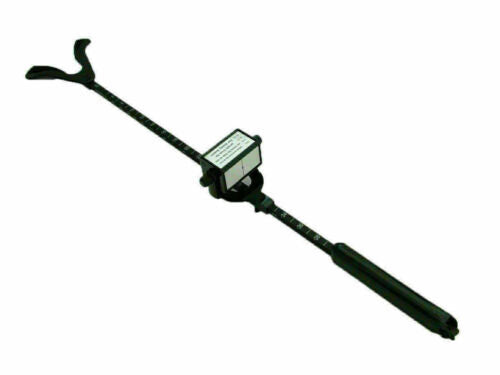
RAF Near Point Ruler — Royal Air Force Eye Muscle Exam Tool
RAF Near Point Ruler — Royal Air Force Eye Muscle Exam Tool
Couldn't load pickup availability
The RAF Ruler (also called the RAF Rule or Royal Air Force Near Point Ruler) is a 50 cm binocular gauge for measuring near point of convergence (NPC), amplitude of accommodation, and master (dominant) eye in 1 mm increments. The RAF near point ruler was originally developed by the British Royal Air Force to screen pilot candidates for accommodative and vergence disorders; today it is standard equipment in optometry practices, orthoptic clinics, vision therapy centers, and optometry schools worldwide. Studies consistently show greater between-tester and test-retest consistency of NPC measurements with the RAF Rule than with pencil-tip or finger targets.
What is a RAF ruler?
The RAF ruler — sometimes written as RAF rule, RAF near point ruler, or Royal Air Force ruler — is a hand-held optometric measurement device. It consists of a straight 50 cm ruler graduated in millimetres, a sliding fixation target holder, a four-sided rotating cube carrying different fixation targets (spot, vertical line, near-reading text of varying sizes), and a fixed cheek rest at one end. In use, the cheek rest sits against the patient's face at the outer canthus, the ruler extends horizontally toward the patient's midline, and the sliding cube is moved toward the eyes to measure convergence, or away from the eyes to measure accommodation amplitude.
What is the RAF ruler used for?
The RAF near point ruler measures four clinically important vision parameters:
- Near point of convergence (NPC) — the closest point at which the eyes can maintain single binocular fusion of a target as it approaches the face. Reported as break point (patient loses fusion, sees double) and recovery point (patient regains fusion). Normal NPC is typically ≤ 6 cm; values > 10 cm suggest convergence insufficiency.
- Amplitude of accommodation — the maximum accommodative range in dioptres. Measured by push-up: the target is moved toward the patient until it first appears blurred. Amplitude = 1 ÷ (distance in metres). Age-normative values decline from ~14 D at age 20 to ~2 D at age 50.
- Master (dominant) eye — determined by having the patient align the ruler ends monocularly.
- Pre-/post-treatment monitoring in vision therapy for convergence insufficiency, accommodative insufficiency, and post-concussion visual dysfunction.
How to use the RAF near point ruler
- Position the patient upright with head in primary gaze. Rest the cheek plate against the patient's face at the level of the outer canthus so the ruler extends horizontally toward the midline.
- Select the target by rotating the cube. Use the vertical line + central dot for convergence testing; use graded near-reading text for accommodation testing.
- Convergence (NPC) test: position the cube at ~30 cm from the eyes. Slowly move the cube toward the patient. Ask the patient to report doubling ("break") — measure and record the distance. Slowly move the cube away — ask the patient to report when the target is single again ("recovery"). Record both values (e.g., break 6 cm / recovery 8 cm).
- Accommodation (push-up) test: position the near-reading target at ~40 cm. Move it toward the patient slowly. Ask the patient to report first sustained blur. Measure the distance and compute amplitude = 100 ÷ distance-in-cm dioptres.
- Master eye test: Ask patient to point at the far end of the ruler with both eyes open. Close each eye alternately — the eye whose closure causes the point to jump is the non-dominant eye.
- Repeat 2-3 times for reproducibility. Record all values in the patient chart.
The 4-sided cube — what each face is for
- Face 1 — vertical line + central dot: primary target for convergence (NPC) testing
- Face 2 — near-reading text (large): for adults with reduced accommodation (presbyopia screening)
- Face 3 — near-reading text (medium): for routine accommodation amplitude testing
- Face 4 — near-reading text (small): for younger patients and orthoptic training
Specification
| Length | 50 cm rule with sliding target holder |
| Measurement increments | 1 mm |
| Target | 4-sided rotating cube with different targets per face |
| Patient support | Integrated cheek rest for consistent positioning |
| Material | Rigid plastic with printed scale |
| Use | Diagnostic (NPC, accommodation, master eye) and therapeutic (vision therapy) |
| Intended user | Optometrists, ophthalmologists, orthoptists, vision therapy clinics, optometry schools |
Clinical applications
- Convergence insufficiency diagnosis (adult and pediatric)
- Accommodative insufficiency and accommodative infacility diagnosis
- Post-concussion vision syndrome assessment
- Pre- and post-vision-therapy monitoring
- Master (dominant) eye determination for sighting-dominance tasks
- Optometry school teaching and student practice
- Orthoptic clinic outcome measurement
Frequently asked questions
What does RAF ruler stand for?
RAF stands for Royal Air Force. The RAF near point ruler was originally developed by the British Royal Air Force to screen prospective pilots for convergence and accommodation disorders before military flight training. The design proved so useful that it was adopted worldwide as a standard optometric tool and is still known as the RAF Ruler or RAF Rule.
What is a normal NPC (near point of convergence) result on the RAF ruler?
A normal NPC break value on the RAF ruler is typically ≤ 6 cm and a normal recovery value is ≤ 8 cm. Values greater than 10 cm break are suggestive of convergence insufficiency, particularly if accompanied by symptoms of asthenopia, diplopia during near work, or headaches with reading.
How is the RAF ruler used to measure accommodation?
Place the ruler with cheek rest against the patient's face at the outer canthus. Position the near-reading target at ~40 cm. Ask the patient to look at the smallest print they can read clearly, then move the target slowly toward the patient. When the print first goes sustainably blurred, measure the distance. Accommodative amplitude in dioptres = 100 ÷ distance-in-centimetres.
What's the difference between RAF ruler and Prince rule?
Both are near-point-of-convergence rulers. The Prince rule (also called the RAF-Prince rule) adds a printed near-reading card with graded print sizes on the sliding target, whereas the classic RAF ruler uses a 4-sided rotating cube with targets on each face. Clinically both are used interchangeably; the RAF ruler is more common in the UK and Commonwealth, the Prince rule more common in North American optometry schools.
Is the RAF ruler suitable for optometry school teaching?
Yes. The RAF near point ruler is standard first-year equipment in most optometry and orthoptic training programs internationally. For teaching-clinic bulk orders (10+ units) contact clinic@scimedstore.com for institutional pricing.
What ages can the RAF ruler be used on?
The RAF ruler is suitable for cooperative patients from approximately age 4 upward. For younger children or non-verbal patients, objective NPC assessment methods (observation of eye movements, cover testing) are typically substituted for the subjective push-up test.
How is the RAF ruler shipped from SciMed?
Direct from our San Jose, California distribution center. Free US ground shipping on orders $100+ with same-day dispatch on orders before 2 PM PT. International shipping available; contact sales@scimedstore.com for landed-cost quote.
Also known as
RAF rule · RAF near point ruler · Royal Air Force ruler · Royal Air Force near point ruler · RAF NPC ruler · near point ruler · accommodation ruler
For optometry-school and orthoptic-clinic bulk orders (10+ units) contact clinic@scimedstore.com or (669) 265-9353.
Share