SciMed
Flocculation Jar Test Apparatus — 6-Jar Coagulation Tester, 5-150 RPM Digital, LED Illumination
Flocculation Jar Test Apparatus — 6-Jar Coagulation Tester, 5-150 RPM Digital, LED Illumination
Couldn't load pickup availability
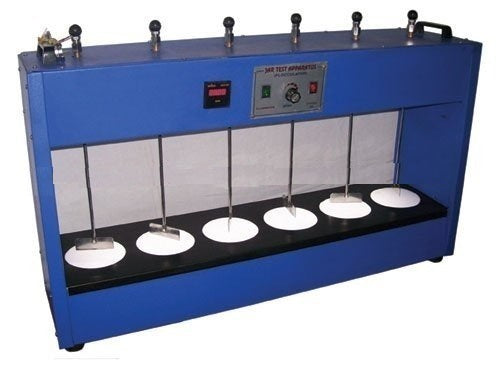
Flocculation jar test apparatus for water + wastewater treatment coagulation optimization — determines optimum coagulant dose, mixing energy, and pH for turbidity + color + organic matter removal. Available in 2, 4, or 6 jar configurations for 1000 mL beakers. Digital variable speed control 5-150 RPM ±1 RPM accuracy, 12mm red LED display, individually removable stainless steel stirring paddles (removable without disturbing other stirrers), acrylic-base cold-light illuminator (fluorescent lamps) for floc visualization. Choose 2-jar ($1,499), 4-jar ($1,799), or 6-jar ($1,999) at checkout. For municipal + industrial water treatment plants, environmental testing labs, and academic environmental engineering programs.
Configuration selection
| Variant | Jars | Best for | Price |
|---|---|---|---|
| 2-jar | 2 × 1000 mL beakers | Small water plant + benchtop screening, university teaching lab | $1,499.99 |
| 4-jar | 4 × 1000 mL beakers | Standard water + wastewater plant daily coag optimization | $1,799.99 |
| 6-jar | 6 × 1000 mL beakers | Full method-of-standard-additions coag dose curve — standard EPA / AWWA approach | $1,999.99 |
Why jar testing matters for water treatment
Optimum coagulant dose (alum, PAC, ferric chloride, polymer) varies with raw water quality (turbidity, alkalinity, pH, organics, temperature). Overdosing wastes chemistry + generates excess sludge. Underdosing lets floc pass into filters + causes finished-water turbidity. The jar test simulates full-scale coagulation → flocculation → sedimentation in a benchtop 6-jar array — dosing each jar with a different coagulant amount, running standard mixing energy profile (rapid mix 100 RPM × 30 sec → slow mix 30 RPM × 15 min → settle 15 min), then measuring residual turbidity to find the dose that gives lowest residual at lowest cost. Municipal + industrial water plants run this test daily; changes in raw water source (rain events, algal blooms, seasonal shifts) require dose re-optimization. Method 2540 + AWWA Standard Methods 2560 recognize jar testing as the primary coag optimization technique.
Specifications
| Jar configurations | 2, 4, or 6 × 1000 mL beakers (select at order) |
|---|---|
| Speed range | 5 to 150 RPM (continuously variable) |
| Speed accuracy | ±1 RPM |
| Display | 12 mm red LED digital display, current RPM readout |
| Stirring paddles | Stainless steel, standard flat-blade design, individually removable |
| Paddle removal | Individual paddles removable without disturbing other running stirrers |
| Illumination | Cold-light fluorescent illuminator, diffused through acrylic sheet base — clear floc visualization |
| Beaker holder base | Acrylic light-diffusing base (also protects fluorescent lamp) |
| Dimensions | 930 × 250 × 480 mm (L × W × H) — 6-jar variant |
| Power | 110V or 220V, 50/60 Hz (specify at order) |
| Warranty | 1-year parts + labor |
Standard jar test method
- Fill each jar with 1000 mL of raw water sample
- Dose different coagulant amounts in each jar (e.g., 10 / 20 / 30 / 40 / 50 / 60 mg/L alum)
- Rapid mix at 100 RPM for 30 seconds (simulates plant flash mixer)
- Slow mix at 30 RPM for 15 minutes (simulates plant flocculator)
- Stop paddles — allow 15-30 minutes settling
- Sample supernatant from each jar, measure residual turbidity (NTU)
- Plot residual turbidity vs coag dose — optimum dose = lowest residual turbidity + minimum coag cost
Applications
- Municipal drinking water treatment plants — daily coagulant optimization
- Industrial wastewater treatment — food processing, pulp + paper, textile dye, mining, chemical plants
- Stormwater treatment — construction runoff, agricultural runoff
- Environmental testing laboratories — contract water testing + treatability studies
- Water research + treatment optimization — polymer selection, PAC vs alum comparison, pH sensitivity
- Cooling tower + boiler water treatment — makeup water coag prior to demineralization
- Aquaculture + fish farm water treatment
- University + college civil / environmental engineering programs — teaching lane equipment
- NGO + humanitarian water treatment — emergency + refugee water treatment training
Best for
- Municipal drinking water plants (0.5 - 100+ MGD)
- Industrial wastewater treatment plants (food/beverage, pulp+paper, textile)
- Environmental engineering + water research labs
- State + regional water quality regulatory agencies
- University civil + environmental teaching labs
- International municipal water development (India, Sub-Saharan Africa, LATAM, SE Asia)
- NGO + humanitarian water treatment training
Buying for a water plant, environmental lab, or university?
- Volume pricing on 3+ orders — university teaching lab fleets, multi-plant municipal orders
- Net-30 invoicing for verified municipalities, environmental labs, universities
- SAM.gov / GSA compliant procurement for federal + state agencies
- Replacement paddles ($60), acrylic base ($150), fluorescent lamps ($20) stocked in San Jose
- Compatible with standard water treatment jar test protocols (AWWA / EPA / Standard Methods 2540 + 2560)
- International DDP shipping — massive municipal water expansion in India, Sub-Saharan Africa, LATAM
- Complete jar test kit — beakers, coagulant syringes, timers, worksheets included on request
FAQ
How does this compare to Phipps & Bird PB-700?
Feature parity — 5-150 RPM digital variable speed, individually removable paddles, cold-light illuminator base, 6-jar configuration. Phipps & Bird PB-700 has slightly more polished operator interface + integrated timer. Price differential: $1,999 (6-jar) vs $4,500-$6,500 for PB-700. For municipal plants + universities, our unit delivers full method compliance at 30-40% of P&B pricing.
What jar size does this use?
Standard 1000 mL round beakers (B34 pattern) — compatible with standard AWWA jar test method. 6 × 1000 mL beakers included in 6-jar configuration.
How do I select 2 / 4 / 6 jar variant?
Select at checkout. 2-jar for benchtop screening + small water plants. 4-jar for standard mid-size plant coag optimization. 6-jar for full method-of-standard-additions (most municipal water plants + universities standardize on 6-jar).
What voltage do I need?
Specify 110V/60Hz (US standard) or 220V/50Hz (international) at order. Email sales@scimedstore.com if uncertain.
Can I use square jars instead of round beakers?
Square jars (2-liter Phipps & Bird style) provide slightly better flocculation dynamics but round 1000 mL beakers are AWWA standard method compliant. Round beakers are cheaper + universally available. Square jars available as accessory upgrade on request.
Share