SciMed
MPA100 Automated Melting Point Apparatus — Pt RTD, Digital Camera, GLP / 21 CFR Ready
MPA100 Automated Melting Point Apparatus — Pt RTD, Digital Camera, GLP / 21 CFR Ready
Couldn't load pickup availability
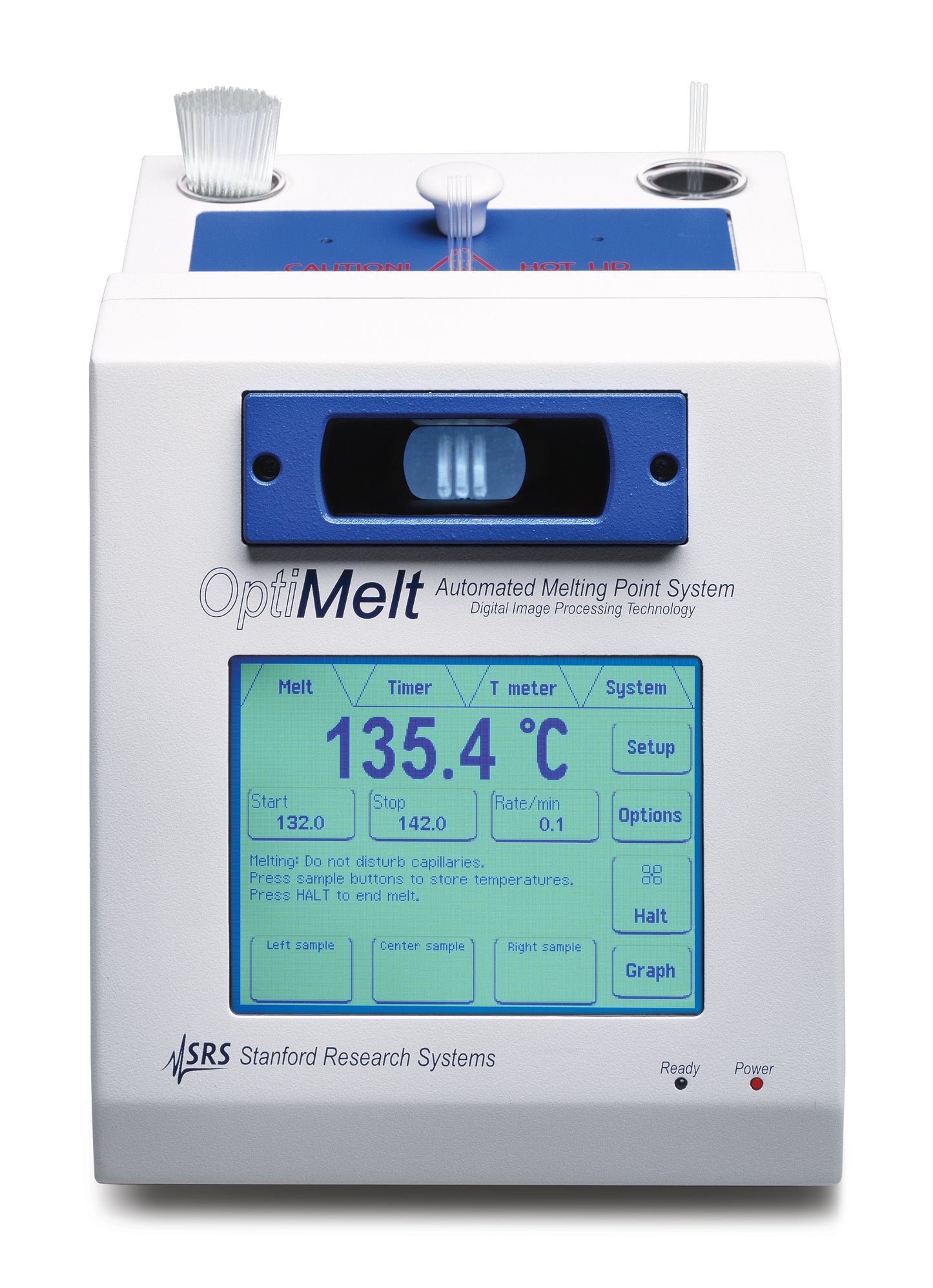
The MPA100 is a fully automated melting point apparatus with a built-in digital camera, PID-controlled temperature ramping, and a platinum RTD sensor accurate to 0.1°C across the range from ambient to 400°C. Determines melting points and melting ranges of pharmaceutical, chemical, and biological substances automatically — with digital image processing that closely matches visual determination results. GLP compliant. USP/EP/JP Pharmacopeia compatible. Optional 21 CFR Part 11 configuration for pharma QC. $5,985 direct — versus $12,000-$18,000 for Büchi M-565 or Mettler MP70.
What the MPA100 does
Traditional melting point determination requires an analyst to stare into a capillary heating block and manually record the temperature at which a solid sample first shows meniscus and where it becomes fully clear — subjective, tedious, and hard to reproduce between technicians. The MPA100 automates this: a built-in high-resolution digital camera captures real-time images of up to 3 capillary samples while microprocessor-controlled temperature ramping heats the aluminum oven at a programmed rate. Digital image-processing algorithms detect phase transitions objectively and record melting point + melting range automatically. Results match visual determination closely — the manual analyst becomes optional, not required.
Automated measurements — how it works
- Load 1-3 capillary samples into the oven block (standard 1.5-2.0 mm OD capillaries)
- Set method parameters — start temperature, ramp rate (0.1-20°C/min in 0.1°C steps), stop temperature, expected melting point
- Hit start — instrument preheats rapidly to just below expected melting point, then ramps at programmed rate
- Digital camera continuously captures real-time images at defined intervals
- Image processing algorithms detect meniscus point (softening) and clear point (fully melted) objectively
- Results displayed on large LCD front panel and automatically recorded to memory (up to 8 complete reports stored)
- Optional manual flagging — dedicated front-panel buttons let analysts tag up to 6 temperatures per sample for cases where automated detection needs override
- Report output — printer, USB to PC, or on-screen review
Specifications
| Temperature range | Ambient to 400°C |
|---|---|
| Sensor | Platinum RTD (Pt100), field-calibrated against certified reference standards |
| Resolution | 0.1°C |
| Accuracy | ±0.3°C (typical, after field calibration) |
| Ramp rate | 0.1 to 20°C/min, adjustable in 0.1°C/min steps |
| Sample capacity | 3 capillaries per run (1.5-2.0 mm OD standard) |
| Detection method | Built-in high-resolution digital camera + image processing (meniscus + clear point) |
| Manual review | Removable magnification lens on front panel |
| Method storage | Up to 24 analysis methods |
| Result storage | Up to 8 complete melting point reports (recallable frame-by-frame or as movie) |
| Interface | Touchscreen with text + numeric entry keypads (no external keyboard needed) |
| Report output | Printer, USB to host PC (MeltView software), on-screen |
| Compliance | USP/EP/JP Pharmacopeia · GLP · 21 CFR Part 11 (optional configuration for pharma QC) |
| Auxiliary functions | Digital thermometer (Pt RTD input) + 3 built-in timers for general lab use between runs |
| Power | 100-240V AC, 50/60 Hz, universal input |
| Warranty | 2-year parts + labor · Pt RTD lifetime |
MeltView software
- Live high-resolution image display of each sample during analysis
- Frame-by-frame + movie playback of stored runs (evidence for QC review + FDA audit)
- Method transfer between MPA100 units (multi-instrument labs)
- Report export to PDF + CSV for LIMS integration
- Optional 21 CFR Part 11 upgrade: audit trail, electronic signatures, user access controls, tamper-evident data
- Runs on Windows 10/11 — connects via USB
Comparison to alternatives
| Feature | SciMed MPA100 | Büchi M-565 | Mettler MP70 | Manual Thiele tube |
|---|---|---|---|---|
| Price | $5,985 | $12,000-$15,000 | $14,000-$18,000 | $150-$400 |
| Temperature range | Ambient to 400°C | Ambient to 400°C | Ambient to 400°C | Ambient to 300°C |
| Sensor | Pt RTD ±0.1°C | Pt RTD ±0.1°C | Pt RTD ±0.1°C | Mercury thermometer ±1°C |
| Detection | Camera + image processing | Camera + image processing | Camera + video | Visual only |
| Ramp control | PID 0.1-20°C/min | PID 0.1-20°C/min | PID 0.1-20°C/min | Manual gas flame |
| Sample capacity | 3 per run | 3 per run | 1-6 per run | 1 at a time |
| 21 CFR Part 11 | Optional | Optional (LabX) | Optional (LabX) | Not applicable |
| Lead time | 7 business days | 4-8 weeks | 6-10 weeks | Same-day |
| Warranty | 2-year parts | 1-year | 1-year | None |
Best for
- Pharmaceutical QC laboratories — API purity + polymorphism screening per USP/EP/JP
- Generic pharma manufacturers — Indian, Chinese, and LATAM formulators exporting to US/EU
- Nutraceutical + herbal medicine producers — active ingredient purity verification
- Chemistry R&D labs — synthesis product identification + reaction progress monitoring
- Contract testing labs — high-volume melting point + purity testing for multiple clients
- Academic teaching labs — organic chemistry undergraduate + graduate courses
- Ayurvedic + Unani + TCM production — traditional medicine QC modernization
- Forensic chemistry labs — controlled substance identification
- Cosmetic ingredient labs — wax + emulsifier + active characterization
- Small-batch specialty chemicals — dyes, pigments, food additives
Applications by industry
- Pharma: API characterization, polymorph screening, USP/EP compendial melting point tests, incoming raw material acceptance
- Chemistry R&D: synthetic product identification, purity assessment (broad melting range indicates impurity), reaction progress
- Herbal / Ayurvedic: lactone + alkaloid + phenolic active characterization, modernizing traditional Vati / Churna QC
- Forensic: unknown crystalline substance screening against reference melting point databases
- Cosmetic: wax + petrolatum + emulsifier melt point QC for formulation consistency
- Food science: fat + oil + specialty ingredient purity verification
- Contract testing: ISO 17025 accredited melting point testing services
Buying for a pharma QC lab, academic institution, or contract testing facility?
SciMed supplies the MPA100 direct to pharmaceutical companies, university chemistry departments, contract testing labs, and forensic laboratories globally.
- Volume pricing on 3+ unit orders — multi-site pharma manufacturers, university teaching lab build-outs
- Net-30 invoicing for verified pharma companies, academic institutions, contract labs
- 21 CFR Part 11 configuration for pharma QC (adds audit trail, electronic signatures, user access controls)
- IQ/OQ documentation available on request for regulated pharma installations
- USP/EP/JP Pharmacopeia reference method validation support
- Calibration standards + capillaries stocked (Vanillin 82°C, Phenacetin 135°C, Sulfanilamide 165°C, Caffeine 236°C, plus custom NIST-traceable standards)
- International DDP shipping — India, LATAM, MENA, SE Asia, GCC, UK, EU, AU/NZ
- SAM.gov compliant for federal + academic procurement
Frequently asked questions
Is this USP/EP Pharmacopeia compatible?
Yes. The MPA100 conforms to USP General Chapter <741> Melting Range or Temperature, EP 2.2.14 Melting Point Capillary Method, and JP 2.60 Melting Point Determination. Method parameters (ramp rate, capillary type, sample preparation) match compendial requirements. Field calibration against certified reference standards (Vanillin, Phenacetin, Sulfanilamide, Caffeine) is included in the standard configuration.
Is the 21 CFR Part 11 configuration available for pharma QC?
Yes — optional configuration adds audit trail (immutable log of every user action + parameter change), electronic signatures (analyst + supervisor sign-off with password authentication), user access controls (role-based permissions), and tamper-evident data storage. Required for GMP pharma QC labs exporting to FDA-regulated markets. Contact sales@scimedstore.com for 21 CFR Part 11 pricing (~$1,500 upgrade).
How does automated detection compare to visual determination?
Digital image processing detects meniscus point (first liquid appearance in capillary) and clear point (fully melted) using contrast + shape-change analysis. Results closely match trained analyst visual determination — often within ±0.5°C. Advantages: objective, reproducible between technicians, generates auditable image record. For unusual samples (colored substances, decomposition-prone materials), manual review via removable magnification lens + front-panel event tagging remains available.
What accuracy can I expect?
±0.3°C accuracy typical after field calibration against certified reference standards. Sensor resolution is 0.1°C. Reproducibility between runs on the same sample: typically ±0.2°C. This matches Büchi and Mettler premium instruments and exceeds USP/EP compendial method requirements.
Can I use this for polymorph screening?
Yes — polymorph identification via melting point difference is a common pharma application. The 0.1°C resolution + reproducibility allows distinguishing Form I / Form II / Form III polymorphs with typical 2-8°C melting point separations. For definitive polymorph confirmation, combine MPA100 data with DSC or XRD.
What samples can I run?
Standard capillary melting point samples: powders, crystals, waxes, small solid pieces (ground to fill capillary). Substances with decomposition, sublimation, or dehydration require careful ramp rate selection. Not suitable for: liquids, gels, biological suspensions, samples requiring inert atmosphere (nitrogen/argon purge not standard — contact us for specialized configurations).
Do I need external software?
No — the front-panel touchscreen handles method setup, sample analysis, result review, and printer output standalone. MeltView software (free download) enables PC-based image review + report export to PDF/CSV + LIMS integration. For 21 CFR Part 11 configuration, MeltView is required for audit trail + electronic signature workflow.
What's the warranty?
2-year parts + labor on all components. Platinum RTD sensor: lifetime warranty (Pt RTDs are inherently stable — expected life 10-15 years in typical lab use). Digital camera: 2-year. Consumables (capillaries, calibration standards) not covered.
Can this replace my Büchi M-565?
Feature-for-feature: yes. Same 400°C range, same 0.1°C resolution, same digital-camera detection, same USP/EP compliance, same 21 CFR Part 11 upgrade path. The MPA100 is at ~50% of Büchi pricing. Two differences: (1) MPA100 has 3-sample capacity vs Büchi's 3-sample (parity), and (2) MPA100 ships in 7 business days vs Büchi 4-8 week lead time.
How is this shipped internationally?
US: FedEx / UPS Ground insured, ~30 lbs boxed. International: DHL Express DDP (~$180-350 depending on country) or ocean freight for 5+ unit orders. Ships to India, LATAM (Mexico/Brazil/Colombia), MENA (UAE/Saudi/Egypt), SE Asia (Indonesia/Vietnam), GCC, UK, EU, AU/NZ. Universal 100-240V power supply — no voltage adapter needed.
Why buy direct from SciMed
- ~50% of Büchi / Mettler pricing — same accuracy, same detection method, same USP/EP compliance, same 21 CFR Part 11 upgrade
- Ships in 7 business days — faster than typical 4–8 week manufacturer lead times
- Real US-based technical support — installation, calibration, method transfer, IQ/OQ documentation
- Pharma-friendly procurement — Net-30, IQ/OQ templates, 21 CFR Part 11 configuration, calibration standards stocked
- International DDP — pharmaceutical + academic markets globally
- 2-year parts warranty + lifetime Pt RTD — typical lab life 10-15 years
- Method templates + calibration standards included in first shipment (Vanillin, Phenacetin, Sulfanilamide, Caffeine reference standards)
Shipping: Free continental US FedEx / UPS Ground insured. International DDP DHL Express or ocean freight. Pharma + academic procurement: sales@scimedstore.com.
Share